Art for Medical Offices: 5 Proven Ways It Transforms Patient Experience…
The waiting room is where your patients form their opinion of your practice. Not the exam room. Not the consultation. The waiting room — before a single member of your staff has said a word.
Art for medical offices is not a decorating decision. It is a patient experience decision. And the research behind it is more substantial than most practice managers realize.
TL;DR: Clinical studies confirm that art for medical offices measurably reduces patient anxiety, lowers heart rates, and improves perception of care quality — before treatment even begins. Read more, here
Here are 5 proven ways the right art transforms your space from a place patients endure to a place they trust.

Think about the last time you sat in a medical waiting room.
The fluorescent light. The outdated magazines. The walls painted the color of mild anxiety. And if there was art — a soft landscape print, a watercolor of indeterminate flowers — you probably stopped seeing it within thirty seconds because it had nothing to say.
Now think about what that environment communicated to you as a patient before anyone took your blood pressure or asked about your symptoms. It said: this place is efficient. It is not warm. It does not think about you.
That impression shapes everything that follows. Patient satisfaction scores. Compliance. Referrals. Whether someone comes back.
Art for medical offices is one of the highest-leverage, lowest-cost environmental improvements a practice can make. Here is exactly what the research shows — and how to do it right.
Why Art for Medical Offices Is a Clinical Decision, Not Just a Design One.
The evidence base for art in healthcare settings has grown significantly. These are not opinion pieces about aesthetics. They are peer-reviewed findings about measurable patient outcomes.
A clinical study at the University of Lausanne investigated whether modern art in emergency department waiting areas reduced patient anxiety and pain during wait times — and found measurable benefits for patients who engaged with art during their wait.
A randomized clinical trial published in 2024 found that patients in designed waiting rooms featuring visual objects had significantly lower anxiety scores and lower heart rates compared to patients in standard waiting rooms, with a p-value under 0.001 — a highly statistically significant result.
Research published in 2025 through the University of Pennsylvania’s neuroaesthetics program confirmed that even brief exposure to visual art reduces stress, negative mood, and anxiety in hospital and clinical settings.
Separate hospital mural research documented reduced anxiety and stress symptoms, decreased work-related stress among medical staff, and improved perceptions of care quality among visitors.
The conclusion is consistent: the physical visual environment in a medical setting directly affects how patients feel, how they perceive their care, and how they report their experience.
Art for medical offices is not decoration. It is environmental medicine.
5 Proven Ways Art for Medical Offices Transforms Patient Experience.
1. It Measurably Reduces Anxiety Before Treatment Begins.
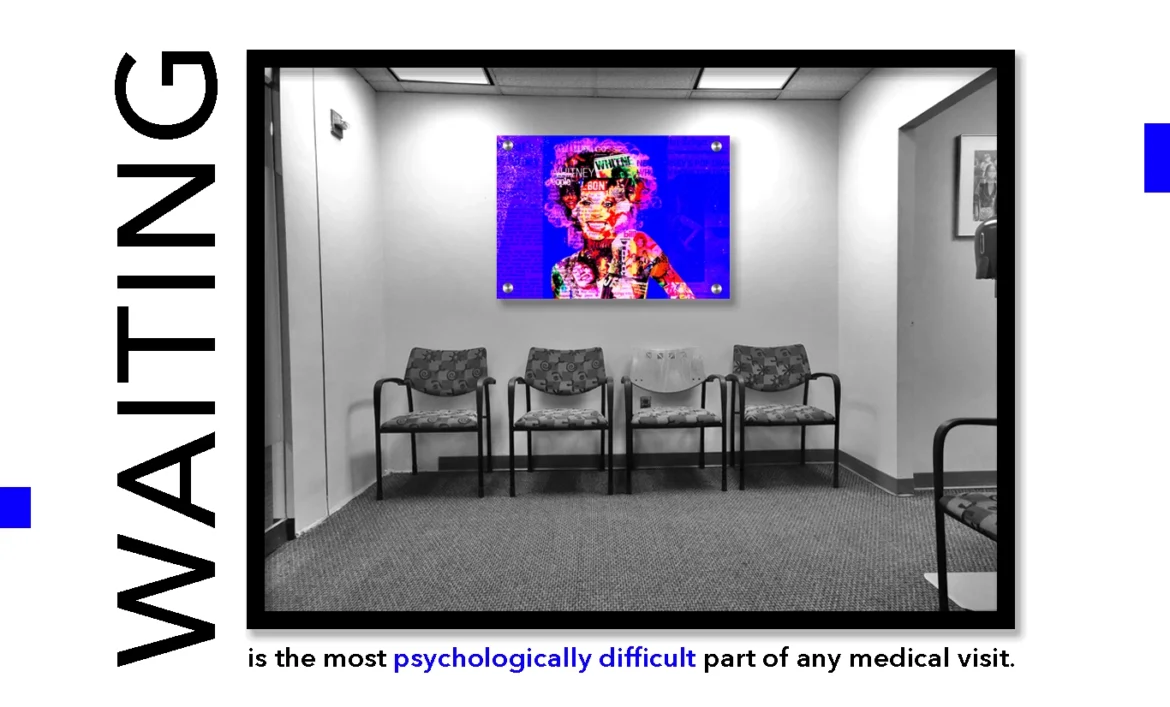
Waiting is the most psychologically difficult part of any medical visit. The uncertainty, the anticipation, the inability to control what comes next — this is where patient anxiety peaks.
Anxious patients are harder to treat, more likely to report negative experiences, and less likely to return or refer.
The clinical evidence is direct: patients in waiting areas with intentional visual art had significantly lower anxiety scores and lower heart rates than those in undecorated standard environments.
The art was doing measurable physiological work before the appointment even started.
For a practice that takes patient outcomes seriously, this is not a marginal benefit. It is a clinical edge built into your waiting room.
The art that produces this effect does not need to be passive or forgettable. It needs to be intentional — chosen because it shifts the emotional register of the space.
Aspirational art, built around stories of resilience and human strength, can be as effective as traditional calming imagery in creating that shift.
The key is that the art says something. Generic prints say nothing, and the data reflects it.
2. It Shapes How Patients Perceive the Quality of Your Care.
This is the finding that surprises most practice managers: patients associate the quality of their physical environment directly with the quality of their clinical care.
Research confirms that patients who view healthcare facilities positively are more likely to rate their overall care experience favorably — demonstrating that the physical environment directly contributes to satisfaction and confidence in care.
Patients also associate well-maintained and thoughtfully detailed environments with quality care, even in facilities that were not recently renovated.
In plain terms: a waiting room with intentional, high-quality art signals to patients that this practice pays attention to detail. That it cares about their experience, not just their diagnosis.
That the standard of care here is higher — before a single clinical decision has been made.
Art for medical offices is patient perception management. And patient perception drives satisfaction scores, reviews, and referrals.
3. It Reduces Staff Stress and Improves Workplace Satisfaction.
The patient experience is not the only one that matters. Medical staff work in high-pressure environments where burnout is a documented, systemic problem.
Hospital art research documented decreased work-related stress among staff in art-enriched healthcare environments.
Staff areas with intentional visual art — break rooms, corridors, nursing stations — contribute to a meaningfully better daily experience for the people your practice depends on.
A practice that invests in its visual environment communicates something important to its team: we think about where you work, not just what you do.
For practice managers dealing with retention challenges, art for medical offices is one of the lowest-cost, highest-visibility investments available.
4. It Survives the Specific Demands of Healthcare Environments.
Medical environments have requirements that standard art media cannot meet — and choosing the wrong material creates maintenance headaches and hygiene risks that negate any benefit.
Healthcare facilities require: non-porous surfaces that do not harbor bacteria, waterproof construction that withstands hospital-grade disinfectant cleaning, no fragile glazing that could shatter, UV resistance under clinical lighting, and scratch resistance in high-traffic zones.
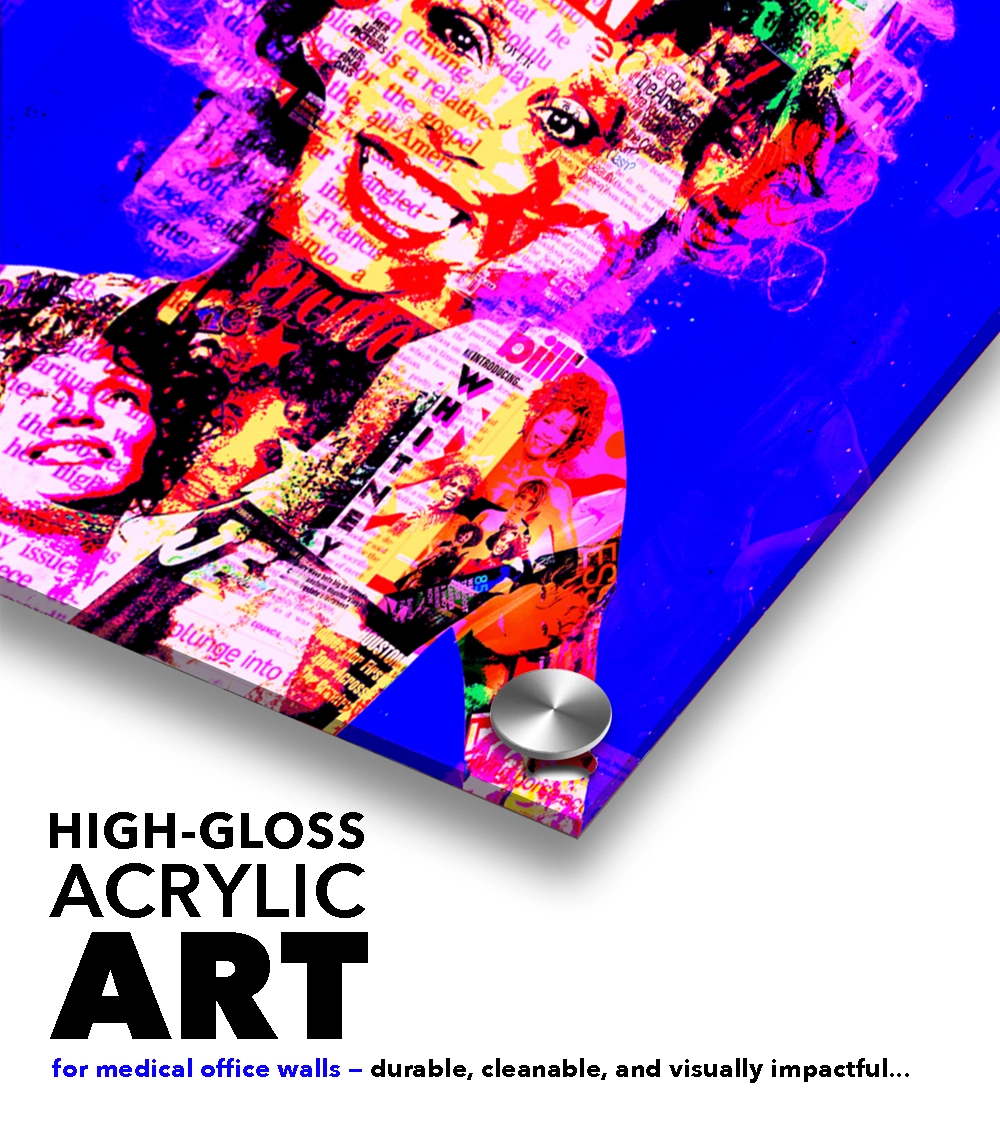
Acrylic meets every one of these requirements. It blocks UV radiation, is virtually scratch-proof, repels dust, and can be cleaned with standard hospital-grade disinfectants without surface or image degradation.
No glass to shatter. No frame to warp. No canvas to absorb moisture.
For a facilities manager or practice administrator responsible for infection control compliance, acrylic is not a stylistic preference — it is the correct specification for a medical environment.
5. It Differentiates Your Practice in a Crowded Market.
Private practices, specialty clinics, and independent medical offices compete on patient experience in ways they did not five years ago.
Patients choose providers. They leave reviews. They refer — or do not — based on how the entire experience felt.
A practice with intentional, memorable, one-of-a-kind art is easy to remember and easy to recommend. A practice with generic prints from a healthcare catalog is indistinguishable from the one across the street.
In 2026, healthcare clients are asking for artwork that feels more elevated, curated, and sophisticated. As clinics and medical campuses begin to look more like hospitality environments, the art is being asked to do more than simply calm a space.
It needs to support healing, reflect the values of the practice, tell a story, and feel intentional.
Art for medical offices from Chaos with Colors is one-of-a-kind by design — every piece made once, sold once, and deleted.
No other practice has what you have. In a market where differentiation drives patient choice, that is a business advantage as much as an aesthetic one.
What Art Works Best in Medical Office Spaces.
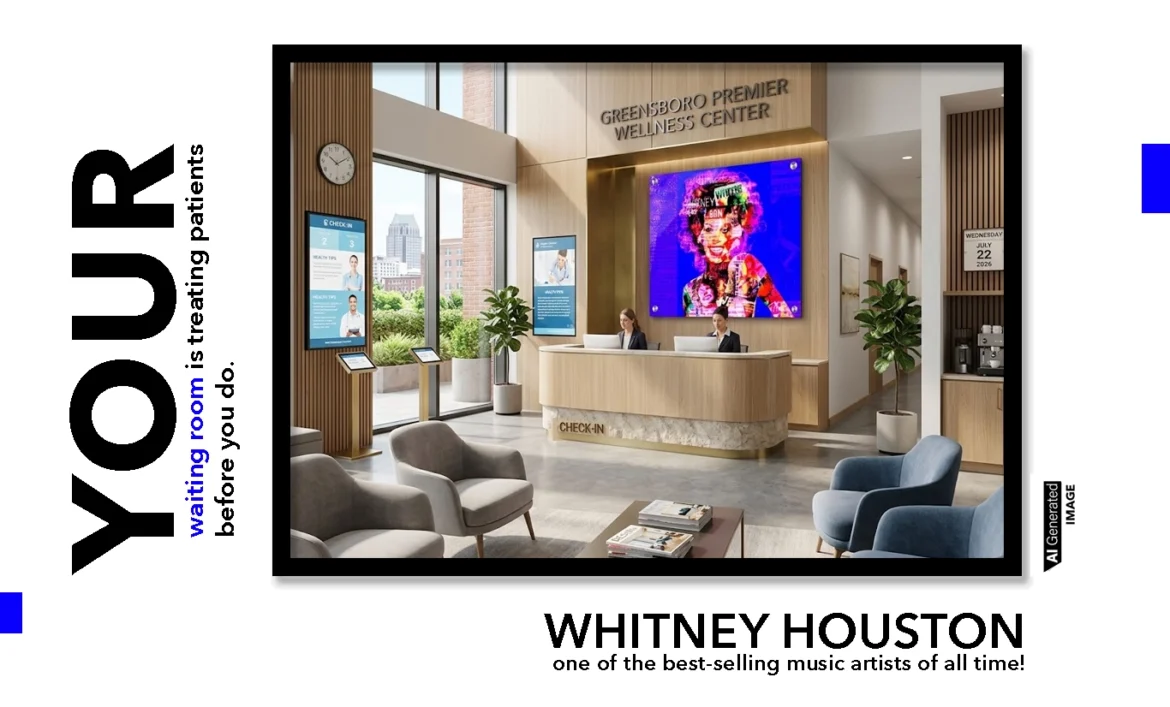
Waiting rooms and reception areas: The highest-impact location. Art that is aspirational and narrative-driven shifts the emotional register of the wait from anxiety to engagement.
Bold does not mean aggressive. A commanding portrait of a figure who overcame the odds is a visual reminder that people get through hard things — which is exactly what patients in a waiting room need to feel.
Procedure and treatment rooms: Calmer, more focused. Art that gives patients something meaningful to look at during procedures reduces perceived wait time and reported discomfort.
Staff areas and break rooms: Uplifting, energizing pieces in staff-only areas contribute to workplace satisfaction and retention. These spaces are often overlooked — the impact on team morale is disproportionate to the cost.
Corridors and transition spaces: A considered series creates cohesion across a facility and makes the journey through the practice feel intentional rather than institutional.
Reception desk and check-in areas: A single strong piece here resets the first impression at the moment of human contact. It gives the front desk team something to reference and invite conversation around.
How to Commission Art for Your Medical Office?
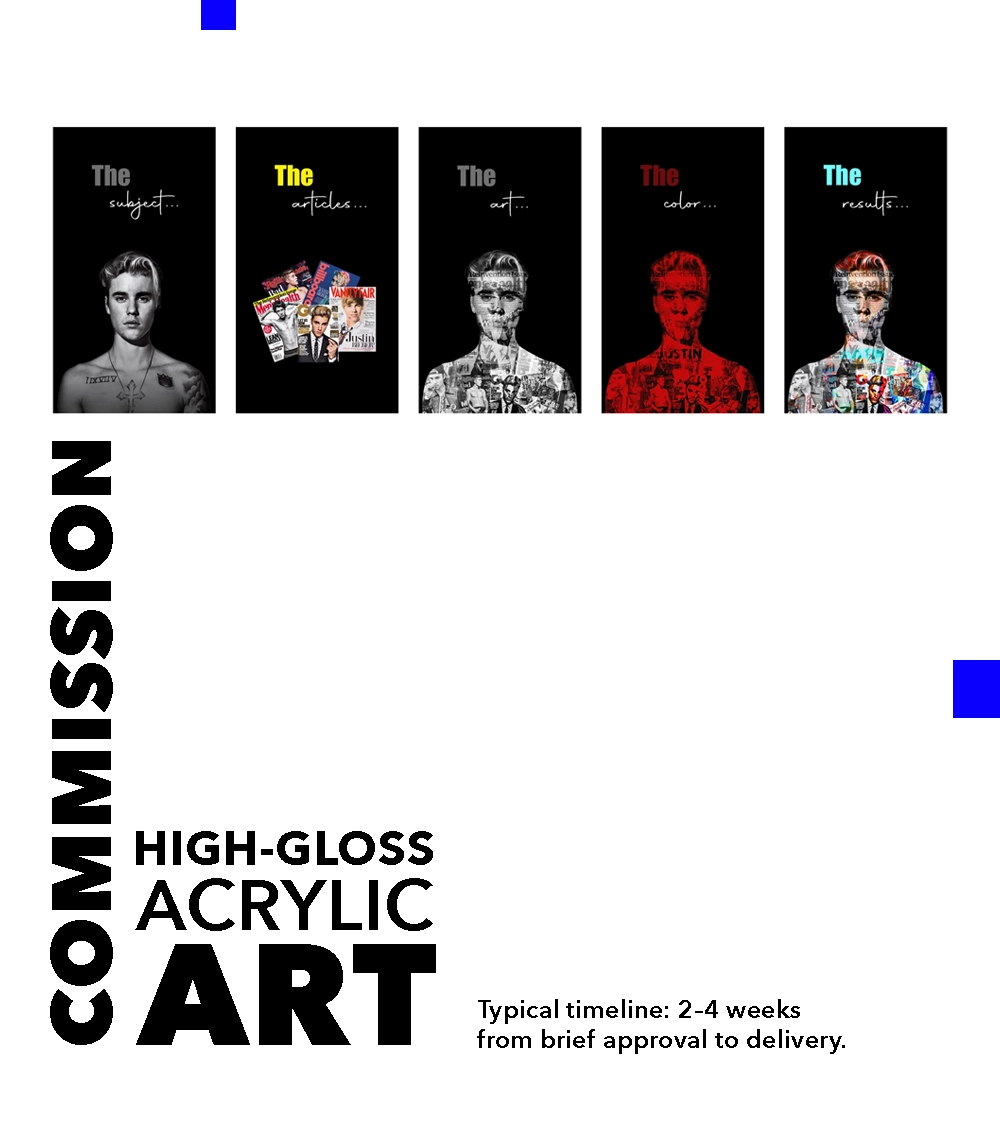
Step 1. — The brief. Tell us about your practice: specialty, patient population, the story you want your space to tell. Share wall dimensions and the spaces you are equipping.
Step 2.— The concept. We research the direction, build the composition in Photoshop, and come back with a concept for your approval. We refine until it is right for your environment.
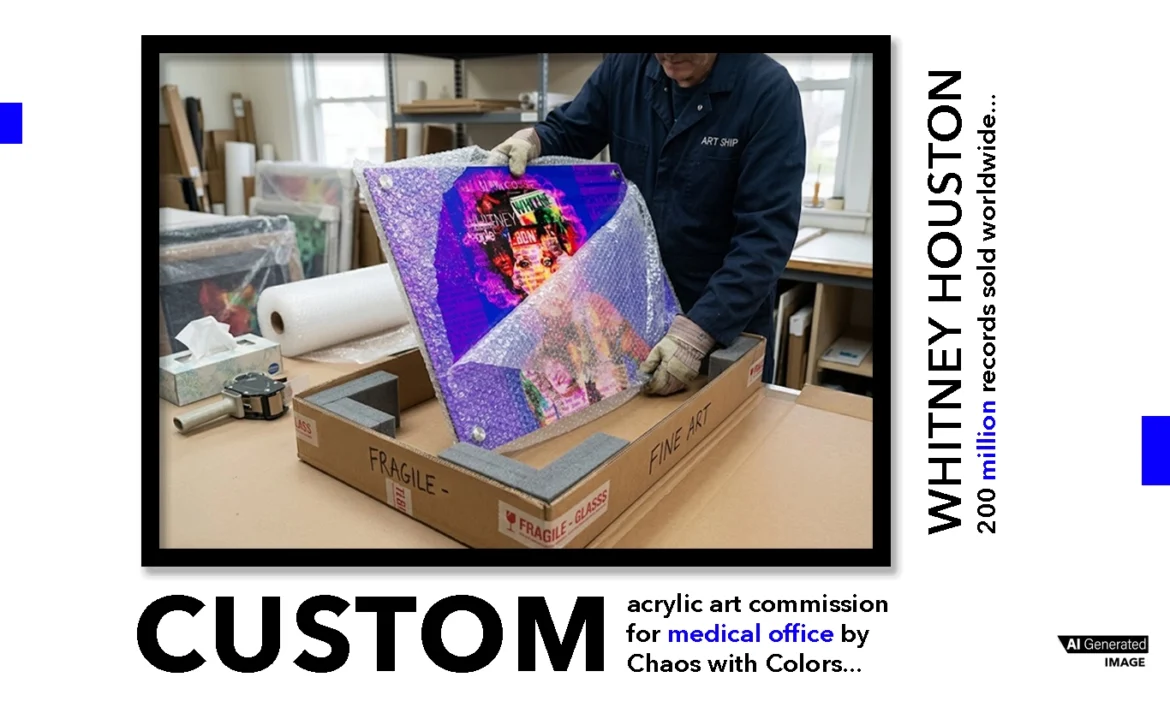
Step 3. — Production. Once approved, we produce on premium high-gloss acrylic through Gelato’s sustainable print network. Non-porous, scratch-resistant, and cleanable with hospital-grade disinfectants.
Step 4. — Delivery. Arrives ready to hang. Typical timeline: 2–4 weeks from brief approval to delivery.
Multi-space programs are available for practices equipping reception, treatment, staff, and corridor spaces across a single location or multiple sites.
→ Start Your Commission, here
→ Explore the Gallery, here
It’s environmental medicine.
It works on your patients before the appointment starts.
It shapes what they think about your quality of care.
Frequently Asked Questions?
Is acrylic art safe and compliant for medical environments?
Yes. Acrylic is non-porous, waterproof, and cleanable with hospital-grade disinfectants without surface degradation.
It is scratch-resistant, contains no fragile glass, and does not harbor bacteria the way canvas or fabric-based art can.
It is one of the most specification-appropriate materials for healthcare environments.
Does the research really support art in medical waiting rooms?
The evidence base is substantial. Multiple peer-reviewed studies and clinical trials have found that visual art in healthcare waiting areas reduces patient-reported anxiety scores, lowers heart rates, and improves perception of care quality.
A 2024 randomized trial found significantly lower anxiety and heart rates in designed waiting rooms versus standard rooms — a statistically significant result at p < 0.001.
What kind of art is appropriate for a medical office?
More than most people assume. Traditional guidance defaulted to calming landscapes and nature imagery — and that still has a place.
But 2026 healthcare design research shows that patients and administrators are asking for art that feels more elevated, curated, and intentional.
Aspirational, narrative-driven art can be as effective as passive nature imagery — and is far more memorable.
Can you create art specific to our medical specialty?
Yes. Bring us the brief: your specialty, your patient population, the values of your practice. A pediatric clinic has different needs than an oncology center, which differs from a sports medicine practice. We build around your specific context.
How durable is acrylic in a clinical environment?
Extremely. It is the recommended material for high-traffic and clinical environments precisely because it withstands intensive cleaning, resists scratching, blocks UV radiation, and repels dust.
Significantly more durable than canvas and eliminates the breakage and safety risks of glass-covered prints.
Can you equip multiple spaces across our practice or facility?
Yes. Multi-space programs are available for practices equipping reception, waiting, treatment, staff, and corridor spaces in one location or across multiple sites.
Every piece remains one-of-a-kind — we do not repeat designs — but programs can be built with cohesive visual language across spaces.
What is the lead time for a medical office commission?
Typically 2–4 weeks from brief approval to delivery. For multi-space programs, contact us early and we will build a realistic timeline into your project plan.
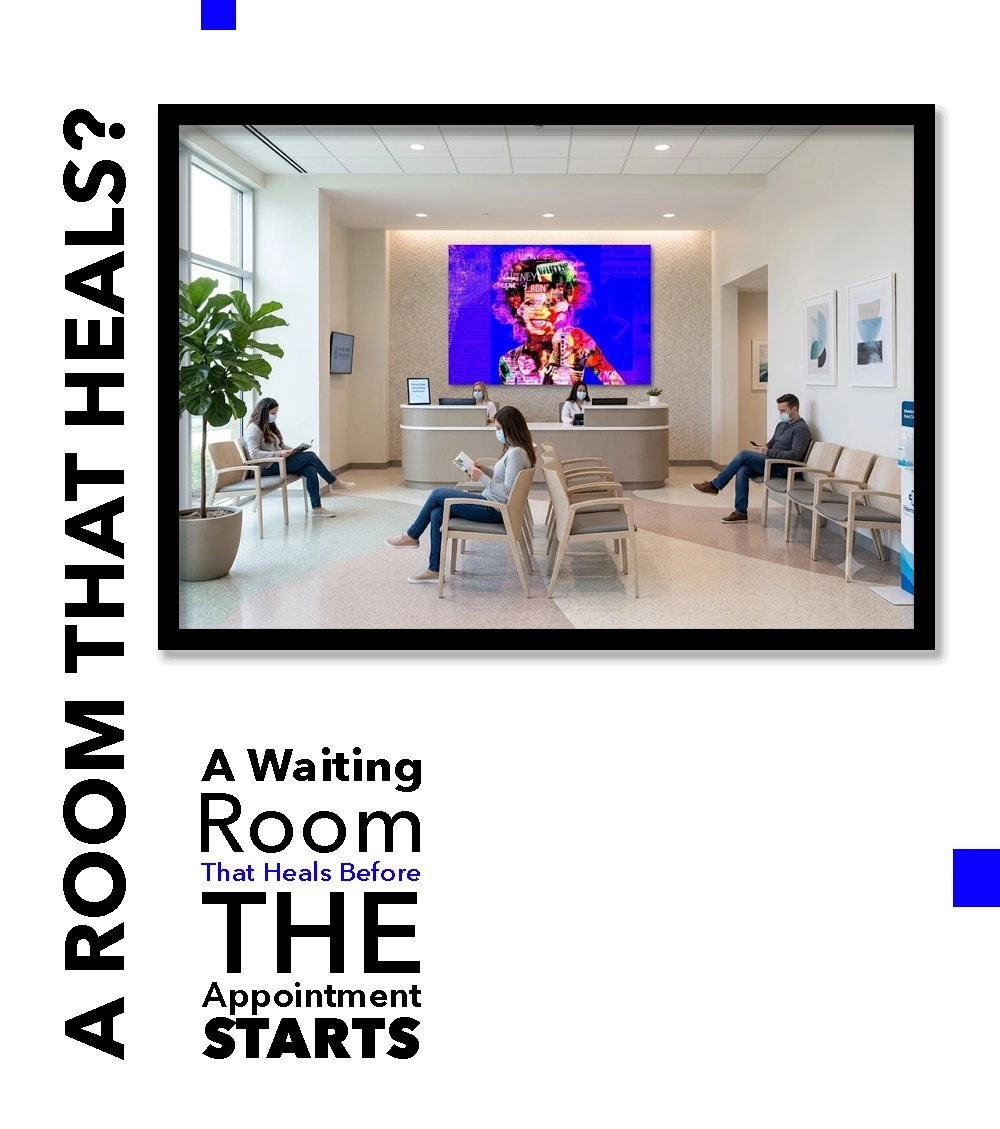
A Waiting Room That Heals Before the Appointment Starts…
The most powerful thing art for medical offices can do is change what patients feel before anyone in your practice has done anything.
Measurably lower anxiety. Higher perception of care quality. A space that says: we thought about you, not just your symptoms.
That is not a small thing. In a market where patient experience drives satisfaction scores, referrals, and retention, it is one of the most impactful investments a practice can make.
→ Commission Your Medical Office Art, here
Chaos with Colors creates one-of-a-kind acrylic art for spaces that refuse to be forgettable. Every piece is made once, sold once, and deleted.
Your practice gets something no other facility has — and material that meets the demands of clinical environments without compromise.
Healthcare art is changing in 2026…
The soft landscapes still have their place but the practices gaining ground are asking for something more — art that feels elevated, curated, and intentional.
Not just art that doesn’t upset anyone.
“There’s a difference between calming & forgettable.”
“I’d rather be alone than unhappy.”Whitney Houston